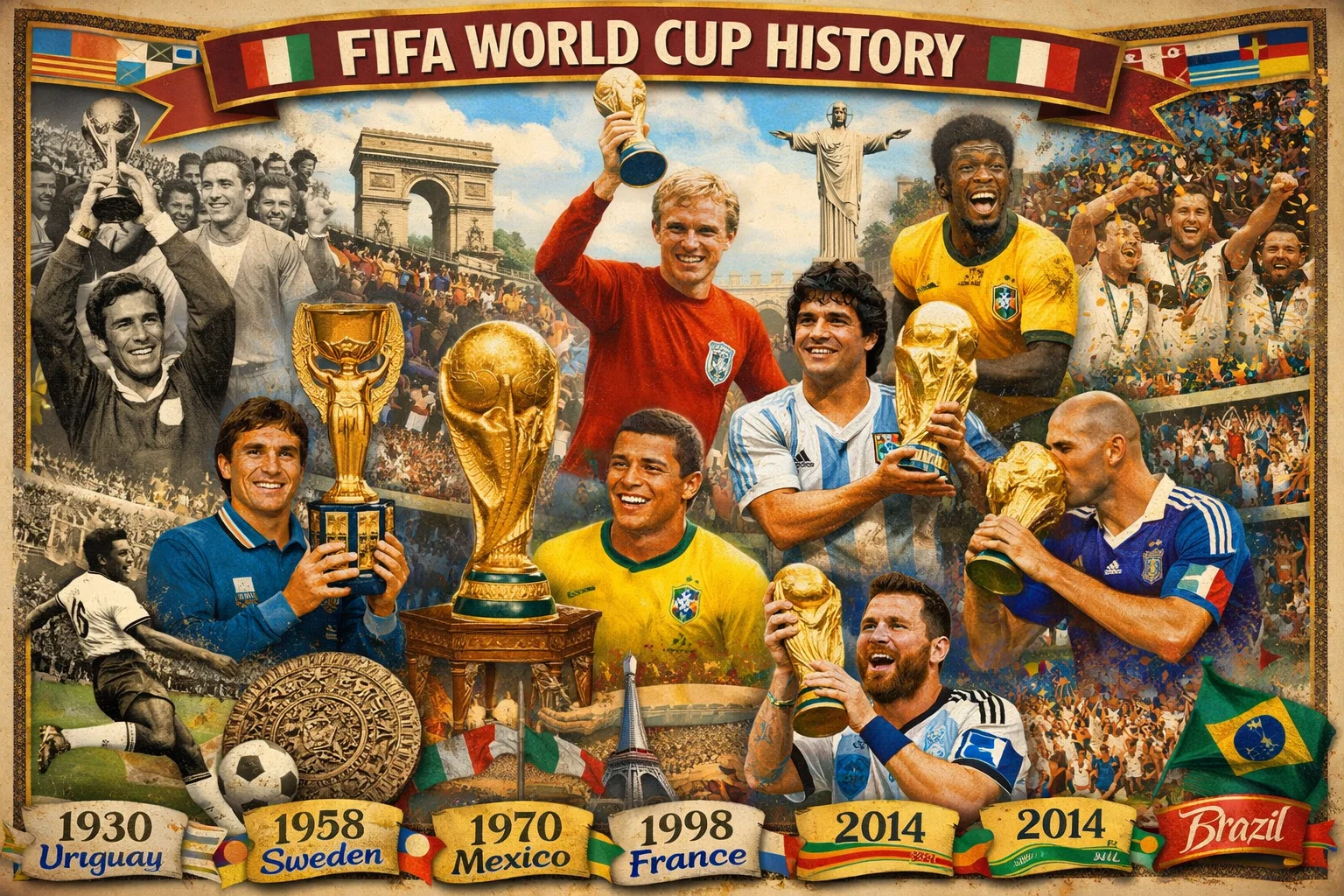
FIFA World Cup History
FIFA World Cup Winners & Runner Ups
The FIFA World Cup is widely regarded as the most prestigious tournament in global football, bringing together the best national teams every four years. Since its inception in 1930, the competition has grown into a worldwide spectacle, watched by billions of fans and featuring the greatest players in history.
Over the decades, the World Cup has produced unforgettable finals, dominant champions, and historic upsets that have shaped the sport. From Brazil’s golden era to Germany’s consistency and Argentina’s recent triumph, each edition tells a unique story of passion, pressure, and glory on the biggest stage.
This article provides a complete breakdown of every FIFA World Cup edition from 1930 to 2022, including host nations, final results, and top goal scorers. It offers a quick yet comprehensive look at how the tournament has evolved and which teams and players have left a lasting legacy.
World Cup 2022
Qatar hosted the first World Cup in the Middle East, played in winter conditions and filled with drama throughout. Argentina defeated France after a thrilling 3-3 draw, winning 4-2 on penalties in one of the greatest finals ever. Lionel Messi delivered a historic performance, while Kylian Mbappé scored a hat-trick. Top scorer: Mbappé with 8 goals.
World Cup 2018
Russia hosted a well-organized and entertaining tournament that brought the World Cup back to Europe. France defeated Croatia 4-2 in the final to secure their second title with a young and dynamic squad. Their balance of speed, creativity, and tactical discipline proved decisive. Top scorer: Harry Kane with 6 goals.
World Cup 2014
Brazil hosted a vibrant tournament packed with attacking football and unforgettable matches. Germany defeated Argentina 1-0 in extra time, with Mario Götze scoring the winning goal. The tournament is also remembered for Germany’s stunning 7-1 victory over Brazil in the semi-final. Top scorer: James Rodríguez with 6 goals.
World Cup 2010
South Africa made history as the first African nation to host the World Cup, symbolizing unity and global growth of the game. Spain defeated the Netherlands 1-0 in extra time, with Andrés Iniesta scoring the decisive goal. Spain’s possession-based style dominated the tournament. Top scorer: Thomas Müller with 5 goals.
World Cup 2006
Germany hosted an exciting tournament known for its lively atmosphere and passionate fan support. Italy defeated France on penalties after a 1-1 draw in the final. The match is famously remembered for Zinedine Zidane’s red card in his final game. Top scorer: Miroslav Klose with 5 goals.
World Cup 2002
South Korea and Japan co-hosted the first World Cup in Asia and the first with two host nations. Brazil defeated Germany 2-0 in the final, with Ronaldo scoring both goals to secure their fifth title. The tournament featured several surprises and breakout teams. Top scorer: Ronaldo Nazário with 8 goals.
World Cup 1998
France hosted a successful tournament that expanded the competition to 32 teams. France defeated Brazil 3-0 in the final, with Zinedine Zidane scoring twice. It marked France’s first World Cup triumph on home soil. Top scorer: Davor Šuker with 6 goals.
World Cup 1994
The United States hosted the tournament, attracting record crowds and boosting football’s popularity. Brazil defeated Italy on penalties after a goalless final, marking the first shootout-decided final. The competition was widely praised for its organization. Top scorer: Stoichkov and Salenko with 6 goals.
World Cup 1990
Italy hosted a defensively focused tournament known for tight matches and fewer goals. Germany defeated Argentina 1-0 in the final through a late penalty, securing their third title. The competition highlighted tactical discipline over attacking play. Top scorer: Salvatore Schillaci with 6 goals.
World Cup 1986
Mexico hosted a memorable tournament filled with iconic performances and dramatic moments. Argentina defeated Germany 3-2 in the final, inspired by Diego Maradona’s brilliance. His performances remain among the greatest in football history. Top scorer: Gary Lineker with 6 goals.
World Cup 1982
Spain hosted the tournament, expanding the format to 24 teams and increasing global participation. Italy defeated Germany 3-1 in the final, with Paolo Rossi playing a crucial role in their success. The victory marked Italy’s return to the top. Top scorer: Paolo Rossi with 6 goals.
World Cup 1978
Argentina hosted the tournament with passionate home support and intense atmosphere. Argentina defeated the Netherlands 3-1 after extra time to win their first World Cup title. The victory remains a historic moment for the nation. Top scorer: Mario Kempes with 6 goals.
World Cup 1974
West Germany hosted a tactically advanced tournament showcasing disciplined football. Germany defeated the Netherlands 2-1 in the final, overcoming the famous Dutch “Total Football” style. The win highlighted Germany’s efficiency and organization. Top scorer: Grzegorz Lato with 7 goals.
World Cup 1970
Mexico hosted a historic tournament known for global television coverage and attacking play. Brazil defeated Italy 4-1 in the final, showcasing one of the greatest teams ever assembled. Pelé played a key role in their success. Top scorer: Gerd Müller with 10 goals.
World Cup 1966
England hosted the tournament and won their only World Cup title. They defeated Germany 4-2 after extra time, with Geoff Hurst scoring a famous hat-trick in the final. The victory remains England’s greatest achievement. Top scorer: Eusébio with 9 goals.
World Cup 1962
Chile hosted the tournament despite recovering from a devastating earthquake. Brazil defeated Czechoslovakia 3-1 to retain their title, showing early dominance in world football. The competition was physical and competitive. Top scorer: multiple players with 4 goals.
World Cup 1958
Sweden hosted the tournament that introduced new global stars. Brazil defeated Sweden 5-2 in the final, with a young Pelé shining on the biggest stage. It marked Brazil’s first World Cup triumph. Top scorer: Just Fontaine with 13 goals.
World Cup 1954
Switzerland hosted a dramatic tournament filled with surprises. Germany defeated Hungary 3-2 in the “Miracle of Bern,” one of the greatest upsets in football history. The match remains iconic. Top scorer: Sándor Kocsis with 11 goals.
World Cup 1950
Brazil hosted the tournament using a round-robin format instead of a traditional final. Uruguay defeated Brazil in the decisive match, creating the famous “Maracanazo.” The result shocked the football world. Top scorer: Ademir with 9 goals.
World Cup 1938
France hosted the tournament during a politically tense period. Italy defeated Hungary 4-2 in the final to retain their title and confirm their dominance. It was the last World Cup before World War II. Top scorer: Leônidas with 7 goals.
World Cup 1934
Italy hosted the tournament and showcased strong national pride. Italy defeated Czechoslovakia 2-1 in the final to win their first World Cup title. The competition marked Europe’s growing influence. Top scorer: Oldřich Nejedlý with 5 goals.
World Cup 1930
Uruguay hosted the inaugural tournament in Montevideo, setting the foundation for global football. Uruguay defeated Argentina 4-2 in the final to become the first world champions. The event marked the beginning of football’s biggest competition. Top scorer: Guillermo Stábile with 8 goals.